Autoimmune or Not? The Diseases That Blur the Lines

Certain conditions that affect the immune system may share features with autoimmune diseases, but they are not formally recognized as such. Distinguishing between immune-mediated disease and autoimmune disease is a challenging endeavor for many reasons, including difficulties in diagnosis and classification, overlapping signs and symptoms, and uncertainties in treatment options.
To navigate the complexity of classifying immune-related conditions, we spoke to two experts: Victoria Shanmugam, MBBS, FRCP, FACR, CCD, director of the Office of Autoimmune Disease Research in the Office of Research on Women’s Health at The National Institutes of Health (NIH), and Kara Wada, MD, founder of the Immune Confident Institute in Columbus, OH.
What Defines an Autoimmune Disease?
According to revised postulates (1), criteria that define autoimmune disease include:
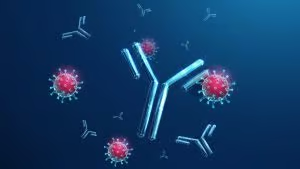
- The presence of autoantibodies and autoreactive T cells
- Evidence that visible clinical features can be reproduced by transferring autoantibodies or T cells
- An ability to replicate a given disease in laboratory animal models
While these criteria still generally apply, the boundaries between autoimmune, immune-related, and chronic inflammatory disease are not always clearly established (1). Criteria also vary by specific conditions and are regularly updated by medical organizations as scientific understanding continues to evolve.
Why Do Some Diseases Stay “In Between”?
Immune-related diseases and comorbidities occupy intersecting positions, affected by both innate and adaptive immune responses that are not always connected to autoimmunity. This overlap contributes to the overall challenge of assigning specific diseases to distinct groups, with some studies highlighting conditions that exist as a spectrum rather than as set categories (2, 3). Some conditions can even coexist with autoimmunity, blurring existing classification parameters and further complicating the clinical picture (4).
Important reasons why some diseases are not considered autoimmune include:
- No single identifiable autoantigen
- No consistent biomarkers
- Diverse symptoms
- Overlap with neurological, hormonal, or metabolic systems
- Historical bias in research (especially for women’s health)
Experts indicate that several gaps need to be closed in terms of classification to improve diagnosis, treatment, and quality of life of people who are affected, including autoantibody testing for various autoimmune diseases (5).
“The ‘black and white’ world of lab data doesn’t always account for the gray areas of immune involvement. While classic autoimmunity requires a ‘smoking gun’ of specific autoantibodies or autoreactive T cells, many conditions live in a space defined by chronic inflammation, hormonal shifts, and/or nervous system dysregulation,” says Wada.
“We see patients with ‘non-specific’ symptoms that are very real, but they lack a neat diagnostic box.”
Shanmugam is one of the leaders of the NIH-Wide Strategic Plan for Autoimmune Disease Research, a framework that promotes research guidance, leverages modern technologies, and builds infrastructure to improve diagnosis and treatment for people with autoimmune disease. “Included within these priorities is an objective to expand autoimmune disease research focused on co-occurring and comorbid conditions, such as endometriosis and fibromyalgia, which commonly co-occur with autoimmune diseases but for which the pathogenesis and mechanisms are currently unclear,” says Shanmugam.
“Suspected” or “Debated” Autoimmune Conditions
“These aren’t necessarily ‘lesser’ conditions; they just challenge our current definitions and frameworks,” says Wada.
Diseases considered “suspected” or “debated” affect the immune system in various and specific ways but are not considered autoimmune diseases. The diseases below affect multiple body systems, organs, and tissues, from the skin to the endometrial tissue to the central nervous system, and are listed along with their key features.
Atopic dermatitis, an immune-mediated disease
- Epidermis barrier disruption
- Immune reactions typical of allergy
- Chronic inflammation
Endometriosis, a chronic inflammatory disease with immune dysfunction
- Hormone-driven inflammatory disease
- Lack of consistent autoantibodies
- Chronic inflammation and pain
Fibromyalgia, a neurological condition with emerging immune evidence
- Neuroimmune disorder
- Musculoskeletal pain
- Combination of genetic, environmental, and neurological triggers
Lyme disease, an infectious disease that is not autoimmune at onset
- Infection caused by Borrelia burgdorferi bacteria
- Bacteria transmitted by tick bites
- Long-term symptoms after treatment (post-treatment Lyme disease syndrome)
“Lyme is the ultimate provocateur,” says Wada. “It can trigger a post-treatment syndrome that mimics autoimmune patterns so closely it blurs the lines of where the infection ends and the immune-mediated disease begins.”
Postural Orthostatic Tachycardia Syndrome (POTS), an autonomic disorder with autoimmune signals
- Dysregulation of blood flow and heart rate
- Autonomic nervous system dysfunction
- Multiple forms (neuropathic, hyperadrenergic, hypovolemic)
Schizophrenia has also been explored as a possible immune-mediated or autoimmune-associated condition, after autoantibodies and inflammation were linked to disease pathogenesis (6). This, however, remains an area of ongoing research and debate.
How Does Disease Classification Affect Research and Clinical Care for Suspected Diseases?
As “multi-omics” and precision medicine research advances, identifying disease has shifted from symptom-based to mechanism-based, leading to classification systems being periodically revised (7) and improving our understanding of disease pathogenesis (8).
“Many conditions we currently group under one diagnosis are likely made up of biologically distinct subtypes,” says Shanmugam. “Advances in genomics, proteomics, and other molecular tools are helping us define those subgroups more precisely, which should support more personalized treatment decisions.”
Classification affects multiple aspects of healthcare and research in immune-mediated disease, including insurance coverage, funding, and access to clinical trials.
“As our understanding of genetics and the microbiome evolves, we hope to see ‘suspected’ conditions shift into ‘accepted’ autoimmune and/or autoinflammatory categories,” says Wada. “An official label shouldn’t be the only way to get validated care, but in our current system, it is often the key that unlocks the door.”
The EXACT-Plan Network is a collaborative initiative that funds research on environmental exposures and how they shape autoimmune disease risk, onset, and outcomes. “Its goal is to build a system-level view of how factors such as chemicals, infections, diet, and other exposures disrupt cells, tissues, and organs across multiple autoimmune diseases,” says Shanmugam. “The EXACT Network is helping move the field beyond studying autoimmune diseases one at a time and toward a more integrated understanding of how environmental factors may trigger and shape disease across the autoimmune spectrum and across the lifespan.”
Why Do Disease Classification Labels Matter?
Classification directly affects disease management, but without clear biomarkers, people who may have an autoimmune or immune-mediated disease may not receive a clear diagnosis or answers for years.
“We’re practicing in an era of incredible diagnostic technology, yet we’re still humbled by the lack of specific biomarkers for many complex conditions,” discusses Wada. “Because symptoms so often overlap with other syndromes, the path to a name is rarely a straight line. This leads to the ‘diagnostic odyssey’, a frustrating cycle of delayed recognition and misdiagnosis that many of these patients know all too well.”
In terms of treatment, research has focused on new biologic agents and engineered cellular therapies to assess whether they can restore immune balance. “We are seeing continued progress in targeted therapies. Rather than relying solely on broad immunosuppression, investigators are now developing treatments aimed at specific immune pathways, with the goal of improving efficacy while reducing toxicity,” says Shanmugam. In terms of research, controlled clinical trials are essential to explore experimental therapies and new tools to effectively monitor disease activity and treatment response.
How can Clinicians, Researchers, and Patients Work Through Uncertainty?
Diagnosis and treatment paths are not always straightforward, but clinicians, researchers, and people with autoimmune and immune-related diseases can take practical steps to make informed decisions amid incomplete information and uncertainty. Wada mentions strongly validating a patient’s experience even when lab results are inconclusive or unclear.
“We have to broaden our definition of ‘do no harm.’ Sometimes, withholding a low-risk intervention just because a patient hasn’t checked every single diagnostic box can be the greater harm.”
She tells her patients to focus on functional outcomes rather than disease labels. “Keep the logs, see the specialists, but don’t let the pursuit of a lab-labeled disease overshadow your quality of life.” Getting helpful answers can take time, so it’s important to communicate with people affected by these diseases and ensure they understand the importance of medical and scientific research.
“Research is rarely a straight line. If we start with what matters to patients, then we are going to be answering important questions,” says Shanmugam.
“Through partnership, every study, even negative ones, can add to a knowledge base that moves the whole field forward.” Partnerships and collaborations are essential to improving our understanding of disease development, even in growing research areas. The area of exposomics measures what (and how) people are exposed to over a lifetime, including diet, environmental factors, and stress, and could help us understand the mechanisms underlying immune disease induction (9).
Community engagement is also key to supporting people with complex immune diseases. NIH’s Office of Autoimmune Disease Research hosts a quarterly forum where community members can hear research updates and share their thoughts and experiences.

About the Author

A freelance writer who specializes in medical and life science topics. As a trained researcher, she authored journal articles in the areas of infection and immunity and wrote booklets and book chapters about different diseases. As a professional communicator, she writes feature articles for magazines and other publications and develops content for higher education platforms. Damiana is also an experienced academic editor, microbiology educator, writing coach, and fragrance blogger. She is a contributing member of the American Medical Writers Association and a past-president of the association’s Southwest Chapter.

Sources
- Article Sources
Hundt, J.E., Hoffman, M.H., Amber, K.T., & Ludwig, R.J. (2023). Editorial: Autoimmune pre-disease. Front Immunol, 14:1159396.
Abacar, K., Macleod, T., Direskeneli, H., & McGonagle, D. (2024). How underappreciated autoinflammatory (innate immunity) mechanisms dominate disparate autoimmune disorders, Front Immunol, 15:1439371k
Szekanecz, Z., McInnes, I.B., Schett, G., Szamosi, S., Benko, S., & Szucs, G. (2021). Autoinflammation and autoimmunity across rheumatic and musculoskeletal diseases. Nat Rev Rheumatol. 17:585-595.
Blanco L.P., Salmeri, N., Temkin S.M., Shanmugam, V.K., & Stratton, P. (2025). Endometriosis and autoimmunity. Autoimmun Rev, 24:103752.
Sciascia S., Bizzarro N., Meroni, P.L., Dimitrios B., & coll. (2023). Autoantibodies testing in autoimmunity: Diagnostic, prognostic and classification value. Autoimm Rev. 22(7):103356.
Shiwaku, H., (2025). Autoantibodies and Inflammation in Schizophrenia. Psychiatry Clin Neurosci. 79:611-618.
Aringer, M., Costenbader, K., & Johnson, S.R. (2022). Assessing the EULAR/ACR classification criteria for patients with systemic lupus erythematosus. Expert Rev Clin Immunol, 18:135-144.
Cheung, P., Khatri, P., Utz, P.J., & Kuo, A.J. (2019). Single-cell technologies — studying rheumatic diseases one cell at a time. Nat Rev Rheumatol, 15:340–354.
Shanmugam, V.K., Temkin S.M., Clayton, J.A., Cui, Y., & coll. (2025). Coordination and Collaboration to Support Exposome Research in Autoimmune Diseases. Arthritis Care Res (Hoboken), 77:12-14.