The Immune Spectrum: From Autoimmunity to Cancer

Our immune system evolved to protect us from invaders like bacteria, viruses, and other microorganisms that could get us sick. In responding to potential threats, our immune system must perform several tasks:
(a) recognize whether something is dangerous or just part of our own body
(b) defend our body against the invading organism by initiating an immune response
(c) shut off the immune response when it’s no longer needed
The Immune System as a Continuum
“The immune system is incredibly complicated,” says Arabella Young, an Assistant Professor at the University of Utah and the University of Utah Huntsman Cancer Institute.
“There are so many different cell types that can contribute to different pathogenesis at different disease sites. We really do think of it as a spectrum because there are different players that come in at different times.”
If you think of the immune system as a continuum, on one end is an underactive immune system, and at the other end is an overactive immune system. Davide Mangani, a Principal Investigator studying cancer and immunity at the Institute for Research in Biomedicine, says that in the middle of this continuum is a “balanced” immune system. In this case, the immune system responds only to infectious organisms without attacking our own cells.
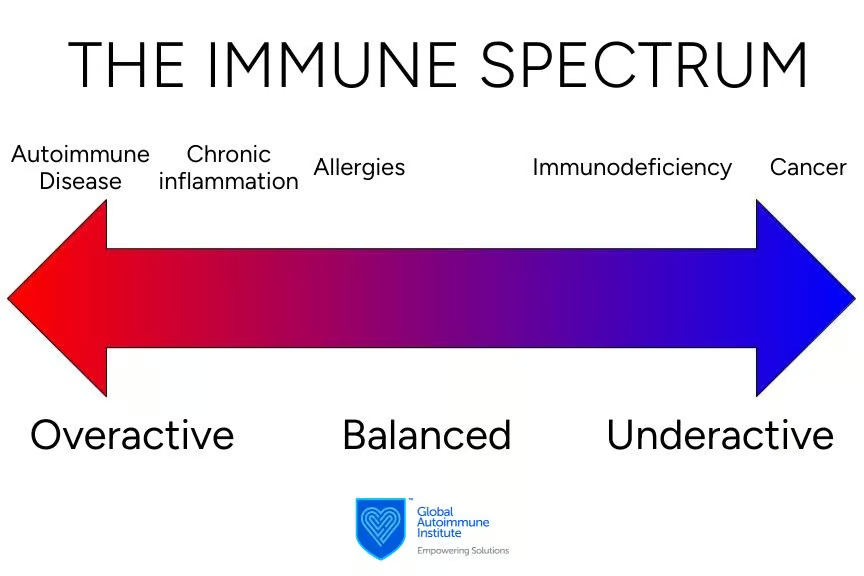
Below, we tease apart the continuum, outlining several diseases and conditions that lie beyond immune balance:
Overactive Immune System:
- Autoimmunity: Autoimmunity sits at the most overreactive end of the immune system spectrum, where the immune system attacks the body’s own tissues. It isn’t necessarily that the immune system functions “excessively,” but rather its inability to distinguish self from non-self is the reason for its overactivity (1). There are over 100 autoimmune diseases.
- Chronic inflammation: Inflammation is a normal part of the immune response when responding to infectious organisms. The problem arises when the inflammation doesn’t stop.
- Allergies: Allergies is an improper immune response to a harmless environmental substance, such as tree pollen or grass. While allergies are a result of an overreactive immune system, they generally aren’t as severe of a response. However, a life-threatening allergy can result in anaphylaxis.
Underactive Immune System:
- Immunodeficiency: Immunodeficiency is a result of an underactive immune system. In immunodeficiency, the immune system is not able to mount a robust immune response against pathogens. Immunodeficiencies can result from infections (ex: HIV), medications (ex: immunosuppressants), aging, and other factors.
- Cancer: Cancer results from the failure of the immune system to recognize and eliminate harmful cells, allowing them to grow unchecked. “Cancer cells, even though they are aberrant cells, are still the cells of the individual,” says Mangani. This, along with other mechanisms to evade immune detection, makes it difficult to eliminate them. “Over time, if cancer cells can persist, they’ll start to modify and evolve to avoid the immune system,” says Young. “Eventually, these cancers will be able to escape the immune system altogether.”
How Do Conditions Like Allergies and Chronic Inflammation Contribute to Autoimmunity?
The immune dysfunction that’s common between allergies and autoimmunity is that the immune system reacts inappropriately to harmless substances. Allergies and autoimmunity share a subset of immune cells that are dysfunctional, although there are cell types unique to each disease. Studies have found that those with allergies have an increased risk of developing an autoimmune disease but research is still ongoing to assess the causality and directionality of these relationships (2).
Chronic inflammation leads to long-term stimulation of the innate immune system and can contribute to the development of autoimmune diseases as well. Chronic inflammation and autoimmunity can feed back into each other where autoimmune responses can intensify inflammation and chronic inflammation can stimulate autoimmune processes. For example, the chronic activation cells of the innate immune system can cause T cells to become self-reactive (3).
How Does Autoimmunity Contribute to Cancer Risk?
While autoimmunity and cancer sit at opposite ends of the continuum, scientific evidence finds that autoimmunity can contribute to cancer risk. This is partly because autoimmunity is characterized by bouts of inflammation. Chronic inflammation can progressively damage tissue, meaning that new cells are continually being produced to replace the damaged ones. At the same time, the proinflammatory environment during chronic inflammation promotes DNA damage. Ongoing cellular regeneration in this environment gives more opportunities for mutations to arise, increasing the risk of cancer (4). Other changes as a result of autoimmunity, including epigenetic changes, also increase the risk of cancer (5).
“There are a number of different examples that autoimmune disease can lead to risk of different cancer types,” says Young.
For example, studies have found connections between the following autoimmune diseases and cancer:
- Autoimmune gastritis and gastric adenocarcinoma (6)
- Crohn’s disease, ulcerative colitis and colorectal cancer (7)
- Rheumatoid arthritis and lung cancer (8)
- Systemic lupus erythematosus and lymphoma (9)
Autoimmune diseases are often managed with immunosuppressive treatments, which can themselves reduce the immune response and increase risk of developing certain cancers.
Changing Perspectives on the Role of the Immune System
Despite their shared pathways rooted in immunology, Mangani says that historically, cancer research and autoimmunity research have developed independently from one another. But things are now changing, where cancer researchers are bringing in the immunological aspects of cancer.
“We are starting to see that there is a merger between immunologist and cancer immunologist,” he adds. “We are really trying to understand how the spectrum of the immune system can be leveraged to treat cancer.”
Because dysfunction along the immune spectrum involves shared immune cell types and pathways, it’s important to think of diseases like autoimmune diseases as part of the continuum of immune function. Treating autoimmune diseases can increase risk of cancer while treating cancer can increase the risk of autoimmune effects. In a future article, we’ll share more about the immune cells and cytokines behind these shifts and how treating autoimmunity or cancer can cause other changes along the immune spectrum.

About the Author

A microbiologist turned freelance science writer who works with life science companies, nonprofits, and academic institutions on anything from news stories, explainer articles, and content marketing. She shares the wonderful world of microbes on her blog The Microbial Menagerie.

Sources
- Article Sources
Xiang, Y., Zhang, M., Jiang, D., Su, Q., & Shi, J. (2023). The role of inflammation in autoimmune disease: a therapeutic target. Frontiers in immunology, 14, 1267091. https://doi.org/10.3389/fimmu.2023.1267091
Wongtrakul, W., Charoenngam, N., Ponvilawan, B., & Ungprasert, P. (2020). Allergic rhinitis and risk of systemic lupus erythematosus: A systematic review and meta-analysis. International journal of rheumatic diseases, 23(11), 1460–1467. https://doi.org/10.1111/1756-185X.13928
Edilova, M. I., Akram, A., & Abdul-Sater, A. A. (2021). Innate immunity drives pathogenesis of rheumatoid arthritis. Biomedical journal, 44(2), 172–182. https://doi.org/10.1016/j.bj.2020.06.010
Greten, F. R., & Grivennikov, S. I. (2019). Inflammation and Cancer: Triggers, Mechanisms, and Consequences. Immunity, 51(1), 27–41. https://doi.org/10.1016/j.immuni.2019.06.025
Li, C. M., & Chen, Z. (2021). Autoimmunity as an Etiological Factor of Cancer: The Transformative Potential of Chronic Type 2 Inflammation. Frontiers in cell and developmental biology, 9, 664305. https://doi.org/10.3389/fcell.2021.664305
Bizzaro, N., Antico, A., & Villalta, D. (2018). Autoimmunity and Gastric Cancer. International journal of molecular sciences, 19(2), 377. https://doi.org/10.3390/ijms19020377
Crohn’s & Colitis Foundation. The Risk of Colorectal Cancer in Crohn’s Disease and Ulcerative Colitis Patients. https://www.crohnscolitisfoundation.org/patientsandcaregivers/what-is-ibd/colorectal-cancer
Simon, T. A., Thompson, A., Gandhi, K. K., Hochberg, M. C., & Suissa, S. (2015). Incidence of malignancy in adult patients with rheumatoid arthritis: a meta-analysis. Arthritis research & therapy, 17(1), 212. https://doi.org/10.1186/s13075-015-0728-9
Zhang, M., Wang, Y., Wang, Y., Bai, Y., & Gu, D. (2022). Association Between Systemic Lupus Erythematosus and Cancer Morbidity and Mortality: Findings From Cohort Studies. Frontiers in oncology, 12, 860794. https://doi.org/10.3389/fonc.2022.860794