PANDAS, PANS, and Autoimmunity

Autoimmune Neuropsychiatric Disorders in Children
For many families, the sudden onset of severe neuropsychiatric symptoms in a child can be alarming and deeply confusing. When those symptoms appear after an infection, it raises even more questions.
Pediatric Autoimmune Neuropsychiatric Disorders Associated with Streptococcal infections (PANDAS) and Pediatric Acute-Onset Neuropsychiatric Syndrome (PANS) are diagnoses that attempt to explain this mysterious connection. While still not fully understood, increasing awareness and research are helping families and clinicians make sense of these complex conditions.
To better understand both the science and the lived reality of these complex disorders, this article features expert insights from Dr. Amy Offutt, an integrative medicine physician and President of the Board of Directors for the International Lyme and Associated Diseases Society, and Julie Cox, LCSW, a child and family therapist who specializes in supporting families affected by PANDAS/PANS.
Origin & Background of PANDAS/PANS
PANDAS was first described in a group of 50 children who developed obsessive-compulsive disorder (OCD) and tics following a strep throat infection caused by group A beta-hemolytic streptococcus (GABHS) (1). Over time, clinicians noticed similar symptom patterns in children without confirmed strep infections. This led to the broader classification of Pediatric Acute-Onset Neuropsychiatric Syndrome (PANS)—a diagnosis that includes a sudden onset of similar symptoms, with or without an identified microbial trigger.
Diagnosing PANDAS/PANS has been controversial given the complex clinical presentation and challenges of establishing the cause (2).
Dr. Offutt is well-acquainted with the complexities surrounding PANDAS and PANS. She affirms the growing body of evidence pointing to an autoimmune process at work in individuals with PANS, explaining, “We know this is an autoimmune disease because of the presence of abnormal antibodies found in so many of these patients.” Dr. Offutt highlights that elevated antibody levels, such as those triggered by post-streptococcal infections and other pathogens, often appear in routine laboratory tests.
Dr. Offutt points out that many families remain unaware of PANS/PANDAS, often enduring prolonged struggles before finding answers.
One of the most significant barriers to care is the reluctance, or outright denial, by some healthcare providers to recognize the condition’s existence.
Misconceptions that families are simply seeking medical explanations for behavioral issues can further delay appropriate treatment. Dr. Offutt also warns that researchers may carry similar biases if they aren’t adequately educated about PANS.
In short
PANS is an umbrella term used to describe cases of sudden-onset neuropsychiatric symptoms triggered by a potential range of infections, environmental factors, or unknown causes.
PANDAS is considered a subset of PANS, limited to cases triggered by group A beta-hemolytic streptococcus (GABHS).
How does PANDAS/PANS Affect the Brain and Body?
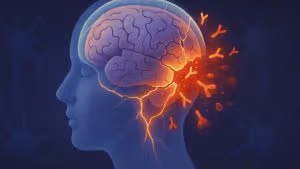
PANDAS/PANS is suspected to be an autoimmune-related condition, where the body’s immune response to an infection or other trigger may mistakenly affect certain areas of the brain.
These regions, including the basal ganglia, play key roles in behavior, emotion, and movement.
One leading theory suggests that this immune response could produce anti-neuronal antibodies that cross-react with brain tissue, potentially contributing to the symptoms seen in affected individuals (3). PANDAS/PANS diagnosis includes the sudden onset of OCD or severe food restriction and at least two of the following symptoms (4):
- Severe anxiety, often with panic attacks
- Mood swings, depression, and emotional lability
- Irritability, aggression, and severe behavior problems
- Behavioral (developmental) regression
- A sudden drop in school performance
- Motor or sensory abnormalities (e.g., tics, hypersensitivity)
- Sleep disturbances, bedwetting, or increased urinary frequency
How is PANDAS/PANS Diagnosed?
Diagnosing PANDAS/PANS can be difficult. Many of the symptoms also appear in more common psychiatric and developmental conditions such as OCD, Tourette’s syndrome, ADHD, bipolar disorder, and eating disorders. Other autoimmune conditions, including autoimmune encephalitis and Sydenham’s chorea (also linked to strep infections), may look similar as well.
How PANDAS/PANS Is Evaluated
Because of the overlap with other conditions, diagnosis often involves ruling out alternative explanations. A typical evaluation may include:
- A detailed patient and family history
- Physical and psychiatric evaluation
- Blood tests, and in some cases, brain imaging
- Identification of possible infectious or environmental triggers
Julie Cox understands the difficulties families face in accessing knowledgeable healthcare providers. Securing appropriate medical care often becomes the family’s most urgent need. In her work, Cox starts by offering parents validation, support, and a sense of hope, she shares“My next step is to work with the parents and provide validation, support, and hope that there is a way through the challenging path of having a child or teen with PANDAS or PANS,” she shares.
For many families, finding clinicians who truly understand these conditions can feel like another obstacle in an already difficult journey. Given the complexity of diagnosis, the American Academy of Pediatrics (AAP) (5) recommends a team-based, family-centered approach to care, ideally anchored by the child’s primary care provider.
Collaborative Teams for PANDAS/PANS may include specialists in:
- Psychiatry
- Psychology
- Neurology
- Rheumatology
- Developmental-behavioral pediatrics
- Occupational and physical therapy
What Causes PANDAS/PANS?
While the exact cause remains unclear, research supports the role of molecular mimicry, when foreign infectious or chemical agents trigger the formation of autoantibodies in genetically or immunologically vulnerable individuals. It’s suspected that these autoantibodies cross the blood-brain barrier and target neurons, particularly in brain regions responsible for mood, behavior, and motor control (3).
Potential risk factors:
- Family history of autoimmune diseases
- Family history of psychiatric disorders
- Pre-existing neurodevelopmental conditions
Animal studies have further supported the autoimmune hypothesis, showing that behavioral changes can occur in mice exposed to these antibodies, and that symptoms often improve with immunosuppressive therapy (3).
How is PANDAS/PANS Treated?
There are currently no standardized treatment protocols for PANDAS/PANS, but care often falls into three main categories (5):
- Psychiatric and behavioral therapies
Cognitive-behavioral therapy and medications can help manage OCD, anxiety, depression, or tics. - Antimicrobial treatments
Antibiotics may be used to treat infections such as GABHS. - Immunomodulatory therapies
Using immune-modulating therapies is controversial because of limited research supporting their benefit. However, some healthcare providers recommend them in more severe cases.
It’s important to address patients’ and their families’ physical and mental health concerns. Typically, medical issues are stabilized before starting therapy.
Therapy can help children and teens develop techniques to better manage the thoughts, feelings, and behaviors associated with PANDAS/PANS. In addition to managing symptoms, therapy can help families cope with the disruptions that PANDAS/PANS can bring to some families.
When working with families, Ms. Cox notes, “I teach parents self-regulation skills and DBT skills to help them through the ups and downs of medical treatment and the challenges that [the] PANDAS [or] PANS child or teen may experience such as OCD symptoms, angry outbursts, executive functioning difficulties, anxiety, and depression.”
PANDAS/PANS Research and Hope for the Future
Children and teens with PANDAS/PANS and their families are leading advocates for more research to help healthcare providers better understand PANDAS/PANS. Dr. Offutt notes, “I see this field evolving because of families who are advocating more and more for their children and adult children who are long-suffering with this condition. It happens often enough that more and more people will have heard of it, and the medical community will have to learn more about it and be able to help these patients and their families.”
There is still much to learn about PANS and PANDAS. Questions remain around causes, diagnosis, and long-term outcomes. However, researchers are actively working to develop diagnostic tools, clarify mechanisms, and identify more effective treatments. As awareness grows, so does hope for earlier diagnosis, more targeted therapies, and better support for families navigating these difficulties.
Families facing PANDAS/PANS can feel isolated and overwhelmed. However, growing recognition from the medical and scientific community is shifting the landscape. We move closer to understanding and healing this complex autoimmune-neuropsychiatric connection with continued research, advocacy, and clinical collaboration.

About the Author

Tracy is a writer, child and adolescent psychiatrist, and leadership coach. Her journey into the world of autoimmune diseases began when she experienced sudden onset symptoms of multiple sclerosis early in her medical career. This personal experience, combined with her intense curiosity, has informed her work and writing in the field. As a writer, Tracy has contributed to various books and written articles related to mental health. She’s also written on various medical topics regularly contributing to publications such as GoodRx, Psychology Today, and Psychotherapy.net

Sources
- Article Sources
Rea, I., Guido, C. A., & Spalice, A. (2021). Clinical features in patients with PANDAS/PANS and therapeutic approaches: a retrospective study. Frontiers in neurology, 12.
La Bella, S., et al. (2023). Pediatric autoimmune neuropsychiatric disorders associated with streptococcal infections (PANDAS): Myth or reality? The state of the art on a controversial disease. Microorganisms, 11(10).
Gagliano, A., Carta, A., Tanca, M. G., & Sotgiu, S. (2023). Pediatric acute-onset neuropsychiatric syndrome: current perspectives. Neuropsychiatric Disease and Treatment, 1221-1250.
Prato, A., Gulisano, M., Scerbo, M., Barone, R., Vicario, C. M., & Rizzo, R. (2021). Diagnostic approach to pediatric autoimmune neuropsychiatric disorders associated with streptococcal infections (PANDAS): a narrative review of literature data. Frontiers in Pediatrics, 9.
Board of Directors. (2025). Pediatric Acute-Onset Neuropsychiatric Syndrome (PANS): Clinical Report. Pediatrics, 155(3).