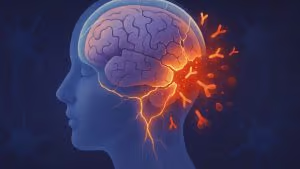
The Importance of Clinical Trials for Autoimmunity

Key highlights from GAI’s presentation at the Autoimmune Warrior Conference, hosted by Aila Health
GAI’s Executive Director, Sandy Boek Werness speaks during Aila Health’s Autoimmune Warrior Conference:
What is the importance of clinical trials in Autoimmune Disease?
Clinical research is vital, especially in autoimmune disease, as studies directly impact medical practice, particularly diagnosis and treatment. Doctors do their best to investigate and learn about the variety of illnesses encountered by their patients, but with the great variability in autoimmune diseases, there are some details that only patients themselves can know about their individual experiences. The best way to begin connecting the dots and help patients better navigate their illness is for patients and clinicians to work together. One major avenue to facilitate this collaboration for improved health outcomes is with clinical research studies, which is why so many of those with autoimmune diseases look to published clinical research studies for guidance.
Clinical research gives us answers, eliminates some red herrings, gives us clues about what to look for, and what kinds of connections can be made.
How does GAI contribute to clinical research in Autoimmune Disease?
Clinical research can be patient and family-driven, funded and supported by academic institutions, hospitals, and the US government, or by nonprofits with the desire to improve diagnosis and treatment. For example, Global Autoimmune Institute funded and helped propel Children’s National Hospital in Washington, D.C. to establish a multidisciplinary clinic for Celiac Disease. This program also runs an ongoing clinical research study to determine how many pediatric patients with Celiac disease experience comorbidities, such as neurological disorders.

This Clinic has brought to light symptoms that have not been openly discussed or previously affiliated with autoimmune disease, such as memory and mood disturbances. The multidisciplinary nature of the clinic has allowed the medical teams to explore under-researched and misunderstood – but debilitating – symptoms such as chronic fatigue and brain fog. They are also able to provide psychosocial support for the children in their day-to-day lives, lifestyle, and medical education for the children and their families, as well as an ongoing support group.
Multidisciplinary clinics are the gold standard in treating all autoimmune disease, and the world is taking notice.
What is mainly being studied in Autoimmune Disease clinical Trials?
Better identification and classification of autoimmune disease, including the recognition of the many symptoms that can arise, and which autoimmune diseases are likely to be found with each other, will allow for better diagnosis.
In addition to finding the most effective tools for managing autoimmune disease, we still need to study details regarding root causes. Why do some people develop autoimmune disease and others do not, even when exposed to the same factors or are in the same family? What are the specific genetic differences and can knowing these help us learn the best treatment options or possibly even cures? It has been established that most autoimmune diseases are triggered by a combination of environmental and genetic factors, though more information is desperately needed in this field.

Photo credit: Ermann, J., Fathman, C. Autoimmune diseases: genes, bugs and failed regulation. Nat Immunol 2, 759–761 (2001). https://doi.org/10.1038/ni0901-759
Right now, most research looking at environmental triggers of autoimmune disease involves the study of viral and bacterial infections, such as Epstein Barr Virus, Coxsackievirus, Herpesvirus, and now SARS-CoV-2 viruses. Pinpointing specific causes will help not only with the prevention of autoimmune disease in the future, but will also help to provide answers and validate the experience of those with autoimmune disease – some of which spring up seemingly out of nowhere, interrupting their previously healthy state.
Clinical research is especially important in the U.S., where our patient data is not accessible or centralized, meaning we don’t have a consolidated database to compile essential information about people and their illnesses. This leaves the burden of spreading crucial information on published information channels such as scientific and medical journals. Doctors and scientists learn from each other at conferences, on online forums, and in other settings, but translating their shared experiences and hypotheses to real data that can be trusted and used to make progress is done primarily through clinical research studies.
How do you find published studies that relate to what you have or are experiencing?
The best source for searching relevant articles is PubMed, the free NIH government website which is accessible to everyone. Simply enter your search terms and read the first part of the article, which summarizes the subject (called the Abstract), to learn what was done and the results they found. Other important journals to look at are Nature, Science, the Journal of the American Medical Association, the New England Journal of Medicine, the Lancet, and the Journal of Autoimmunity.
How do clinical research studies work?
Doctors or scientists (often researchers are practicing doctors who also do research) have an idea they want to test, so they write a plan (called a protocol), which is then reviewed by other doctors and/or scientists (called peer review) to make sure it makes sense and is worth doing based on what we already know relating to the idea. A team is formed and gets funding, the plan is approved by an ethics committee, and hospitals agree to help by recruiting patients who want to participate and who fit the study’s eligibility criteria. Important rules of scientific inquiry and patient privacy are followed.
Should I join a clinical trial? How can I find one?
It is a very personal decision. It is possible that whatever is being tested may help you, and if not, you are certainly helping others. Autoimmune disease can run in families, so the results may help your children, relatives, friends, and the overall community. It can also be a good way to focus on yourself and what you are experiencing, which can feel inspiring, empowering, and validating.
The best way to find a clinical trial that is specifically related to your situation is to talk to your specialist(s) to see if they know of any clinical studies being done that correspond with your diagnoses, symptoms, or other factors. You can also browse the NIH website.
What does participation involve?
That depends as clinical trials vary depending on what it is they are trying to accomplish. You may need to give saliva or blood or other biosamples to be tested, at regular intervals. You may need to take medicine(s), and record and report how you feel. You may need to be given certain tests such as an MRI, or EEG. You may decide to enroll in an observational study and record certain aspects of what you eat, or your activity level, and how you feel, in order to determine how certain lifestyle variables affect your health.
What us being done to further Autoimmune Disease research?
Congress is recognizing that the NIH needs a strategic research plan and coordination across institutes and centers to optimize collaboration in autoimmune disease and has called for the creation of an Office of Autoimmune Disease/Autoimmunity Research in the Office of the Director of the NIH. This is a very big and necessary change as autoimmune disease research had previously been under the National Allergy and Infectious Disease division.
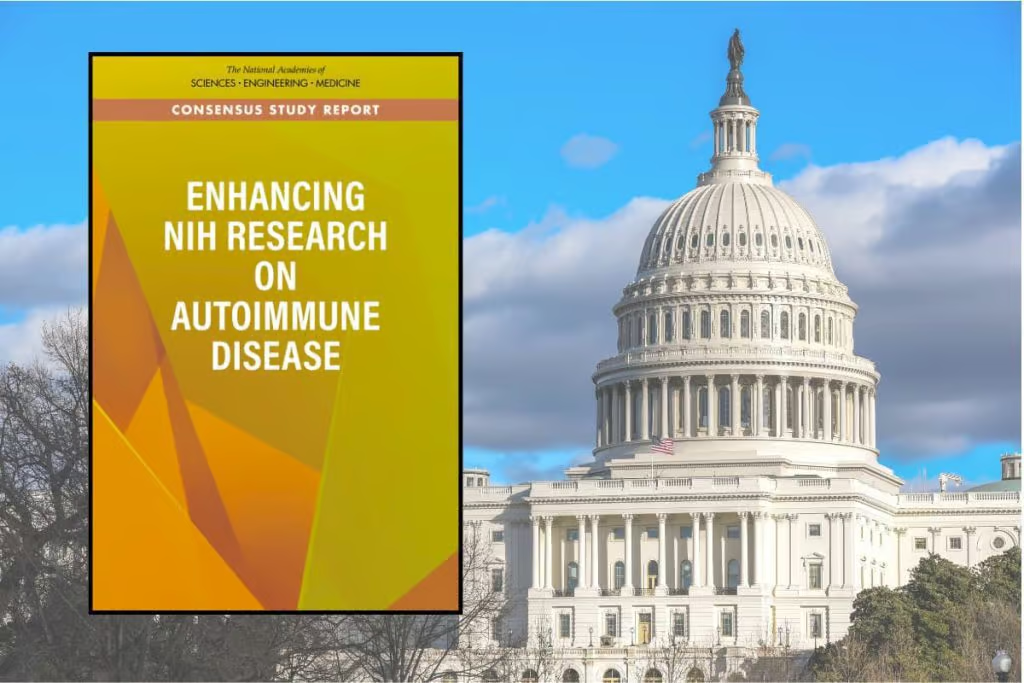
Read the National Academies of Sciences, Engineering, and Medicine’s report on Enhancing NIH Research on Autoimmune Disease here!