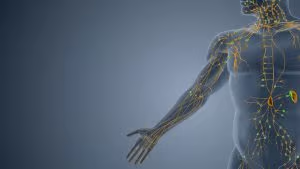
Breaking the Silence: Navigating Stigma and Shared Challenges in Long Covid and Autoimmune Disease

Individuals with Long Covid may experience debilitating symptoms – as well as associated stigmas. But in important respects, Long Covid has also contributed to a conversation about the de-stigmatization of chronic illnesses, including autoimmune disease.
“The hope is that the floodgates will open and that other people with invisible illnesses will be able to come to the table and talk about their invisible symptoms and be welcomed and embraced,”
says James C. Jackson, Director of Long-Term Outcomes at the ICU Recovery Center at Vanderbilt University.
Here, The Global Autoimmune Institute looks at some of the progress.
Parallel Symptoms Between Long Covid and Autoimmune Diseases
Long Covid can present over 200 symptoms, which cause issues throughout the body, including the nervous, cardiovascular, gastrointestinal, pulmonary, and immune systems. Symptoms include fatigue, muscle pain, joint aches, brain fog, headaches, dizziness, depression, anxiety, sleep problems, breathing difficulties, and loss of smell.
Other research suggests that the “depletion of certain anti-inflammatory gut bacteria“ as a result of COVID-19 may lead to lingering inflammation or that some individuals may develop a leaky gut, which allows gut microbes to enter the bloodstream, leading to chronic inflammation. Those who report Long Covid symptoms may also experience immunologic dysfunction marked by alterations in immune cells and proteins. (1)
Symptoms of autoimmune diseases may include fatigue, joint pain and stiffness, muscle aches, skin problems, breathing difficulties, depression, anxiety, and fever. Imbalances in the microbiome may also be an activator for autoimmune conditions, with gut microbe health and autoimmune disease found to be closely related.
For Dr. Melanie Sloan of the Department of Public Health and Primary Care at The University of Cambridge, fatigue is one of the most life-changing symptoms experienced by both patients with systemic autoimmune diseases and Long Covid.
“It permeates – and often destroys – almost every aspect of people’s lives, from being unable to work, to socialize, to carry out all those roles and activities that give our lives meaning and pleasure,” she said. “I’ve interviewed many patients who have told me that they would happily lose decades of their lifespans in exchange for just a few years of having no fatigue since many have no quality of life at all.”
Stigmatization of Long Covid and Autoimmune Disease
According to one study published in the journal PLOS One, 95% of those suffering from Long Covid experienced stigma related to their condition. Roughly 61% of respondents said they were careful about who to talk about their illness to, and 34% said they had “sometimes“ regretted telling people that they had Long Covid.
Individuals suffering from autoimmune diseases, such as lupus, inflammatory bowel disease (Crohn’s disease and ulcerative colitis), and multiple sclerosis, have described similar sentiments. Up to 79% of individuals with a diagnosis of multiple sclerosis were found to have experienced some degree of stigma in the workplace, according to a study in the International Journal of Environmental Research and Public Health.
In a separate study by Dr. Sloan and colleagues, it was found that almost 50% of lupus patients experienced suicidal thoughts, with interviews revealing that fatigue frequently made lives unbearable and or made people feel “worthless” and excluded. (2)
Those suffering from all types of chronic illness often share concerns that non-visible symptoms may be dismissed or scrutinized by doctors, employers, family, and friends.
“We have found many similarities between Long Covid and autoimmune diseases such as lupus, not just in the shared persistent debilitating symptoms such as severe fatigue and cognitive dysfunction, but also in the frequently reported patient experiences of feeling these symptoms are not taken seriously by some clinicians and society,” Dr. Sloan said. “These symptoms often can’t be seen and can’t be tested for with blood tests and brain scans.”
Symptoms may also shift or prove ambiguous, diagnoses may change, and accurate causes and treatment plans can be difficult to pinpoint.
Medical practitioners, in turn, may have a limited understanding of what is actually occurring and how to provide care.
“What you’re left with to make the diagnosis is the patient’s account and often we’ve found that unfortunately symptoms have to be seen to be believed and have to be personally experienced to be truly understood,” Dr. Sloan said.
Advances Related to Long Covid and Potential Impacts on Autoimmunity
The pandemic has led to extraordinary developments in funding, research, and knowledge for Long Covid. In 2023, the Department of Health and Human Services announced the formation of the Office of Long Covid Research and Practice, as well as Long Covid clinical trials through the National Institutes of Health (NIH). The trials are part of a $1.15 billion nationwide research program aimed at improving the lives of Long Covid patients.
In addition, many researchers are exclusively dedicated to understanding the effects of Long Covid at a large network of more than 300 newly established clinics, such as the Center for Post-COVID Care at Mount Sinai in New York City. Other measures include support programs, such as one at Vanderbilt University, which is actively helping patients cope with Long Covid.
There is also ongoing work to illuminate the relationship between autoimmune disorders and COVID-19 directly, including therapies aimed at preventing overactive immune systems from causing severe symptoms.
Among the disorders linked to COVID-19 are rheumatoid arthritis, systemic lupus erythematosus, and vasculitis, as well as inflammatory bowel disease and type 1 diabetes.
In addition, research has shown that the risk of autoimmune and inflammatory diseases is significantly higher in individuals who have had COVID-19.
One study, for example, identified a 42.6% higher likelihood of acquiring an autoimmune condition up to 15 months after an infection from Covid-19. Likewise, people with pre-existing autoimmune disease have been found to be at greater risk of having more severe COVID-19.
Going Forward
James C. Jackson, who is also the author of “Clearing the Fog: From Surviving to Thriving with Long Covid,” believes that divorcing Long Covid from other chronic conditions is a grave mistake, and he notes that chronic patients with so-called “invisible conditions” have had an impact on the course of Long Covid, too.
“While those illnesses are not the same as Long Covid, they have taught us about how people thrive, about acceptance, about the role of mental health, about the impact of families, and about PTSD in the context of medical conditions,” he said.
“We know a lot because we’ve observed many similar issues in patients with multiple sclerosis and lupus. And that understanding is highly relevant to engaging people with Long Covid.”
Going forward, he hopes that any stigma related to chronic illness is increasingly replaced by a movement to be kind and thoughtful – and that patients are able to regain their trust in disclosing their conditions and symptoms to family, friends, and providers.

Sources
- Article Sources
Pesheva, E. (2023, August 9). The most important question about long covid. Harvard Medical School. https://hms.harvard.edu/news/most-important-question-about-long-covid
Sloan, M et al. Prevalence and identification of neuropsychiatric symptoms in systemic autoimmune rheumatic diseases: an international mixed methods study. Rheumatology; 26 Jul 2023; DOI: 10.1093/rhe/kead369