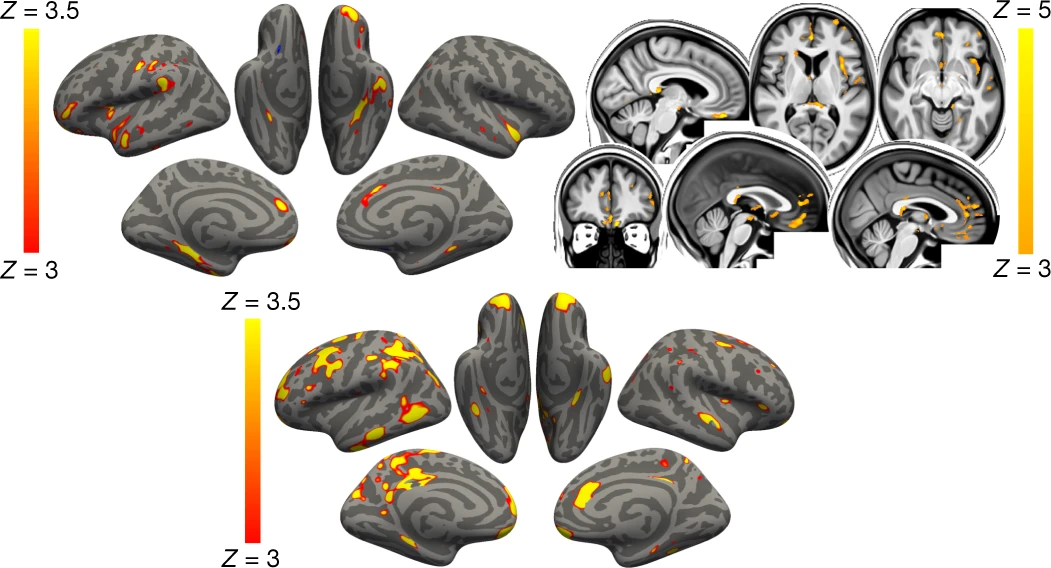
Empirical evidence is beginning to clarify how COVID-19 may affect the brain.
In a large-scale study published in Nature in March 2022, researchers from the University of Oxford analyzed brain scans from 785 adults, ages 51 to 81, participating in the UK Biobank project. Among them, 401 had tested positive for COVID-19, and 384 served as uninfected controls.
By comparing scans taken before and after infection, researchers found that those who had COVID-19 showed greater reductions in gray matter and overall brain volume than those who had not been infected.
The areas most affected were the orbitofrontal cortex and parahippocampal gyrus, regions linked to smell, memory, and emotion.
Subtle signs of tissue damage also appeared in regions connected to the olfactory cortex, consistent with the loss of smell that often accompanies infection. These regions are part of the limbic system, which helps regulate emotion and memory. Participants who had been infected also showed slightly greater cognitive decline over time, performing more slowly on tests of attention and executive function.
Importantly, these changes were observed even among people who had mild or asymptomatic infections.
Researchers believe they may reflect inflammation or reduced sensory input through smell pathways rather than direct viral invasion of the brain. Ongoing follow-up studies aim to determine whether these structural and cognitive changes improve with time or contribute to persistent symptoms seen in Long COVID.
Citation
Douaud, G., Lee, S., Alfaro-Almagro, F. et al. SARS-CoV-2 is associated with changes in brain structure in UK Biobank. Nature604, 697–707 (2022). https://doi.org/10.1038/s41586-022-04569-5