
Get to know the Research we Fund
GAI is increasing knowledge and progress in autoimmune disease by funding important scientific investigations. We are a moving force in propelling collaboration and awareness in science and medicine. Information on some ADs is much less available than others – we are on our way to help change that.
A Brighter Future for Children with Neuroimmunological Conditions
Background Information:
Pediatric neuroimmunological conditions are a group of neurologic disorders predominantly characterized by inflammatory responses in the central nervous system and are autoimmune in nature. In children with these autoimmune conditions, the body’s natural defense system attacks its own healthy cells. Neuroimmunological conditions specifically target the brain and nervous system. Many of these complete conditions are idiopathic and arise spontaneously, leaving previously healthy children with a lifetime of illness and challenges. Neuroimmunological conditions can affect a child’s ability to eat, walk, talk, think, see or move normally.
Children’s National Hospital
Children’s National Hospital is home to one of the few comprehensive pediatric neuroimmunology programs in the country and some of the nation’s leading Neuroimmunology experts. Their specialists have expertise in caring
for children with a wide range of neuroimmunological conditions, including autoimmune encephalitis, neuromyelitis optica spectrum disorder (NMO or NMOSD), multiple sclerosis (MS), myelin oligodendrocyte glycoprotein antibody disease (MOG or MOGAD), acute disseminated encephalomyelitis (ADEM), opsoclonus-myoclonus-ataxia syndrome (OMAS), primary CNS vasculitis, transverse myelitis, acute flaccid myelitis (AFM), new-onset refractory status epilepticus (NORSE), and febrile infection-related epilepsy syndrome (FIRES).
Research Aims:
To develop and implement new investigative studies and clinical trials for children with neuroimmunological conditions. More specifically:
- Identify shared immune dysregulatory pathways in patients with immune-neurologic conditions
- Discover potential genetic causes of clinically characterized but genetically uncharacterized neuro-inflammatory diseases
- Characterize the clinical disease manifestations to generate a comprehensive assessment of neurological and non-neurological disease indicators, and
- Collect longitudinal functional outcomes, including neurologic status, functional status, neurocognitive outcomes, and quality of life.
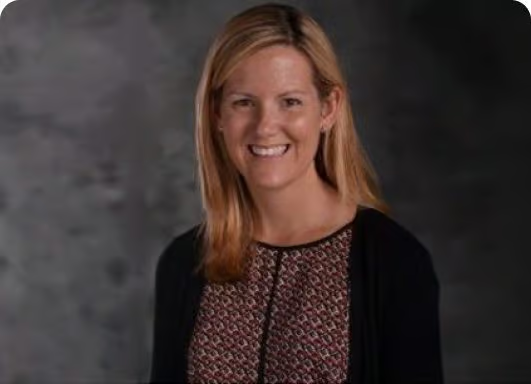
Čiháková Research Laboratory
Long Covid (PASC) Study
Background Information:
Acute SARS-CoV-2 infection (COVID-19) is associated with both high cardiovascular morbidity and mortality. After an acute infection, some patients fail to fully recover and suffer for an extended period of time. Commonly referred to as “Long Covid,” this phenomenon is technically called Post-Acute Sequelae of SARS-CoV-2 (PASC). PASC is characterized by a high prevalence of persistent cardiac symptoms (such as chest pain, shortness of breath, arrhythmias, and decreased cardiac function). Remarkably, more than 25% of patients hospitalized with COVID-19 are found to have myocardial injury. However, the extent to which immune responses—such as myeloid cells, lymphocytes, and cytokines—may contribute to cardiovascular involvement in acute COVID-19 and in PASC is unknown. The duration of cardiovascular morbidity in PASC patients is also unknown.
The immune profile of patients with cardiovascular PASC is understudied. To date, there have been no long-term studies investigating systemic markers in patients with PASC. Consequently, there is a need to understand the determinants of cardiovascular sequelae along the acute COVID-19 to PASC disease spectrum with attention to the immune profile.
Research Aims:
Daniela Čiháková, M.D., Ph.D., has assembled a team of cardiologists, virologists, and experts in animal modeling at Johns Hopkins to collaborate with her on this project. The team will examine sera and immune cells from the blood of patients that were seen at the Johns Hopkins’ Long Covid clinic. These samples will be compared to healthy controls and samples from patients who tested positive for Covid in the past but completely recovered. The samples will undergo immunological, clinical, and imaging assessments.
Cancer Therapy Induced Autoimmune Myocarditis Study
Background Information:
Myocarditis is an inflammatory disease of the heart muscle cells, and myocarditis is most often caused by a viral infection. Giant cell myocarditis and eosinophilic myocarditis are rare but particularly severe types of myocarditis. About 30% of myocarditis survivors develop dilated cardiomyopathy (an enlargement and weakening of the heart muscle), one of the most common reasons for heart transplantation in all ages.
Immune checkpoint inhibitors (ICI) have transformed the treatment of a wide spectrum of cancers. These therapies target molecules called “programmed cell death protein 1” (PD-1) and its ligand (PD-L1) (anti-PD-1/PD-L1 therapy). However, this new cancer therapy can lead to immune-related adverse events when autoimmune inflammation affects various organs. Immune-related adverse events are typically not life-threatening and manageable. However, autoimmune myocarditis has emerged as a rare but fatal complication of ICI therapies. Mortality for this ICI-associated myocarditis is high—50% of affected patients died.
Research Aims:
Dr. Čiháková’s team will investigate the protective mechanism of the PD-1/PD-L1 interaction in the myocardium (the cardiac source of PD-L1 that protects the heart from myocarditis), the ability of the PD-1/PD-L1 pathway to prevent myocarditis progression to dilated cardiomyopathy, and the therapeutic potential of forced PD-L1 overexpression in myocarditis/dilated cardiomyopathy treatment.
GAI-Funded Publications
- Daoud, A., Kalinoski, H., Talor, M. V., Welsh, R. A., Jo, W., Jaime, C. M., Kolim, B., Mahto, N., Kveton, M., Weislová, I., Melenovský, V., Fabián, O., Kiemen, A. L., & Čiháková, D. (2025). Whole-heart 3D reconstruction of mouse CVB3 myocarditis reveals spatial and transcriptomic heterogeneity of immune foci. Cardiovascular research, 121(17), 2777–2790. https://doi.org/10.1093/cvr/cvaf209
- Campos Ramos, Gustavo, Daniela Čiháková, Christoph Maack, and Sumanth D. Prabhu. “Interface Between Cardioimmunology, Myocardial Health, and Disease: A Compendium.” Circulation Research 134, no. 12 (2024): 1661-1662.
- Čiháková, Daniela. “T Cells and Macrophages Drive Pathogenesis of Immune Checkpoint Inhibitor Myocarditis.” Circulation 149.1 (2024): 67-69.
- Jo, Wonyoung, Taejoon Won, Abdel Daoud, and Daniela Čiháková. “Immune checkpoint inhibitors associated cardiovascular immune-related adverse events.” Frontiers in immunology 15 (2024): 1340373.
- Kalinoski, et al;“Injury-induced myosin-specific tissue-resident memory T cells drive immune checkpoint inhibitor myocarditis.” PNAS (2024)
- Won, Taejoon, Evelyn J. Song, Hannah M. Kalinoski, Javid J. Moslehi, and Daniela Čiháková. “Autoimmune myocarditis, old dogs and new tricks.” Circulation Research 134, no. 12 (2024): 1767-1790.
- Won, Taejoon, Hannah M. Kalinoski, Megan K. Wood, David M. Hughes, Camille M. Jaime, Paul Delgado, Monica V. Talor, Ninaad Lasrado, Jay Reddy, and Daniela Čiháková. “Cardiac myosin-specific autoimmune T cells contribute to immune-checkpoint-inhibitor-associated myocarditis.” Cell reports 41, no. 6 (2022). https://doi.org/10.1016/j.celrep.2022.111611
- Daoud, Abdel, Diego A. Lema, Taejoon Won, and Daniela Čiháková. “Integrative single-cell analysis of cardiac and pulmonary sarcoidosis using publicly available cardiac and bronchoalveolar lavage fluid sequencing datasets.” Frontiers in Cardiovascular Medicine 10 (2023): 1227818.
Advancing Autoimmune Understanding
This GAI-LJI collaboration seeks to leverage LJI’s expertise in immunology through the Center for Autoimmunity and Inflammation to unravel the mysteries of autoimmune disease and develop novel treatments.
In 2024, GAI launched a new research partnership with LJI, including the creation of the Global Autoimmune Institute Assistant Professorship. Seminars such as Life Without Disease and Live from the Lab, a short film, a digital resource guide, and Immune Matters magazine features were also supported through this collaboration.
In 2025, this support expanded to a five-year, $1 million commitment, deepening our investment in long-term autoimmune research.
Learn more about our strategic partnership with LJI here.
Dr. Sam Myers
Dr. Myers investigates how immune cells process information and how signaling errors can lead to autoimmune disease. His lab uses advanced mass spectrometry and proteomics to study these molecular decisions. In 2024, GAI helped fund the purchase of the Astral mass spectrometry platform, enhancing his lab’s ability to track the signals that drive immune dysfunction. His work also explores how immune pathways intersect with brain health, offering insights into symptoms like brain fog and sensory sensitivity.
Characterizing the Autoantibody and Genetic Profiles of Patients with Multiple Autoimmune Conditions
Background:
The research team at Boston Children’s Hospital will use blood samples to simultaneously test for multiple autoantibodies associated with many different autoimmune conditions using autoantigen microarray panels. Utilizing this technology, the team will investigate whether there are identifiable autoantibody signatures that can distinguish individuals who have only one autoimmune condition from those who have multiple.
Research Aims:
The hope is to discover biomarkers that can be used to identify individuals who are at risk of polyautoimmunity prior to their development. The team will then use these findings to develop a standardized approach to screen and care for patients with multiple autoimmune conditions.


Find past Research Grants & Projects
Funding studies on autoimmune disease is central to GAI’s mission. We are proud to have had a part in its advancement, from groundbreaking research that helped answer what causes lupus to develop to establishing clinics for multidisciplinary care. We continue to support researchers at the highest-ranking academic and medical institutions across the US.