


Share Your Autoimmune Story
Welcome to the Global Autoimmune Institute and our community!
We look forward to your Autoimmune Story submission! Personal stories are so inspiring and helpful. They bring us together and provide comfort and useful information to those who need it most. We appreciate your effort on behalf of others who, like you, are on this difficult journey.
How to Tell Your Chronic Illness Story
Through stories, we create connection and understanding—in relation to others, but also for ourselves.
Have you been thinking about telling your chronic illness or autoimmune story? Maybe you want to keep a private record of what it’s been like to live with health issues. Or maybe you want to share your experiences with friends and family. No matter the reason, remember that it can be as simple or as involved as you make it.
Understanding why you’re writing, learning helpful tips and tricks, and identifying a starting point can help you shake off the overwhelm and take action.
7 reasons to tell your story
Your mind is most likely teeming with endless questions, worries, opinions, emotions, and information all the time—even if you don’t realize it. Think of Dumbledore tapping a wand to his head, and leading a trail of shimmering thoughts into a glowing, glass orb. Writing is a way to let things out and release the pressure.
You don’t have to record just one version of your story; your perspective will change overtime. Write periodic journal entries or recaps of your chronic illness journey to help your future self better understand what happened, and what has improved or worsened.
The act of sharing your story may start a conversation. You can make new friends with people who relate to what you’re going through.
It’s not easy to talk about these kinds of things, but the more you practice, the more confident and empowered you’ll feel. You’ll also be in a better position to educate those around you and raise awareness, if that is a path you’re looking to take.
Writing down thoughts and memories can have the powerful effect of shifting the way we see things and bringing new ideas to light. You never know—it could trigger a “eureka!” moment.
We all know there are too many people out there without adequate support. Reach out with your own personal story and be one more hug, one more smile, one more voice insisting, “You’re not alone.”
Assumptions, social constructs, and other factors can get in the way of true understanding. Add your voice to the collection of insider stories circulating online. It helps friends, relatives, healthcare professionals—all the people around you—better understand what life with a condition like yours is really like.
Writing tips!
- Celebrate what makes you, you. You may have a disease, but you are not your disease. Your story does not need to solely be about illness, but about what makes you unique and how your qualities as a person have brought you to this point in your journey.
- Write as if you’re talking to a friend. Use conversational language and let your personality come through.
- Keep your notes from doctor visits, journal entries about symptoms, text messages, etc. Gather all your information in one place to better recall details of your story.
- Create a timeline. Years of symptoms, medical visits, tests, research, protocols, therapies—and everything else in between—can easily become a jumbled, overwhelming mess in your head.To more easily write your story and piece together a clearer picture of your journey as a whole, grab a pen and paper. Mark time intervals along a line and jot down significant events that changed the trajectory of your illness (first symptoms, diagnoses, test results, surgeries, treatment plans, etc.).
- Let your present emotions fuel your writing. You don’t have to be in any particular headspace to write your story. You may find just the right words during a bad day or good day, and taking out your pen or laptop no matter what you’re feeling can contribute to a more rounded picture of your experience.
- Use your senses. Sound and smell are powerful ways to unearth memories. Listening to music from the time period you’re focused on, or smelling a lotion you used or food you frequently ate can unlock specific feelings you had at the time.
- Know who you’re writing for. You may be writing primarily for yourself, but you also might have others in mind – a friend with autoimmune disease, someone with new symptoms who don’t know where to turn, a relative who is having trouble understanding what you’re going through. It can be helpful to have them in your head- however, remember that this doesn’t need to be for anyone else.
- Ask for input. Friends or family members could have interesting insights and different perspectives on your experience. Call them up and ask questions about what they remember during different points in your journey.
- Don’t downplay your experience. Give the gift of allowing yourself to be honest about what this is like for you. Many of us are used to sugar-coating how we feel in order to make the people around us more comfortable. This is your chance to tear down that wall. Be open about both the negative and the positive.
- Ignore that voice of judgment. As you write, the only one who gets to see those words is you! You are the only reader, so don’t be worried about how you sound, about writing a “good story”, or about it being perfect. You (or a friend) can edit it later.What matters is that you’re honest. No matter what your goal is in writing this, focus on letting your authentic self come through.
- Let the creativity flow. “Writing” your story doesn’t mean you have to write an essay. Note feelings or memories in bullet points, draw or paint scenes and images, write a poem or a play, create a meme, or record a video.
- Explain the lingo. If you decide to share your story with others, be sure to briefly define terms or phrases that people outside the chronic illness or autoimmune disease community may not understand, like ANA testing, brain fog, SIBO, hypothyroid, LDN, etc.
- Use an emotional intelligence wheel. This is a helpful tool to peel away surface emotions like anger and sadness and get to root emotions hiding underneath. Pinpointing what you felt from the very beginning to now – at all the various stages – helps your story resonate with readers, and emphasizes the roller coaster ride that is living with chronic illness.
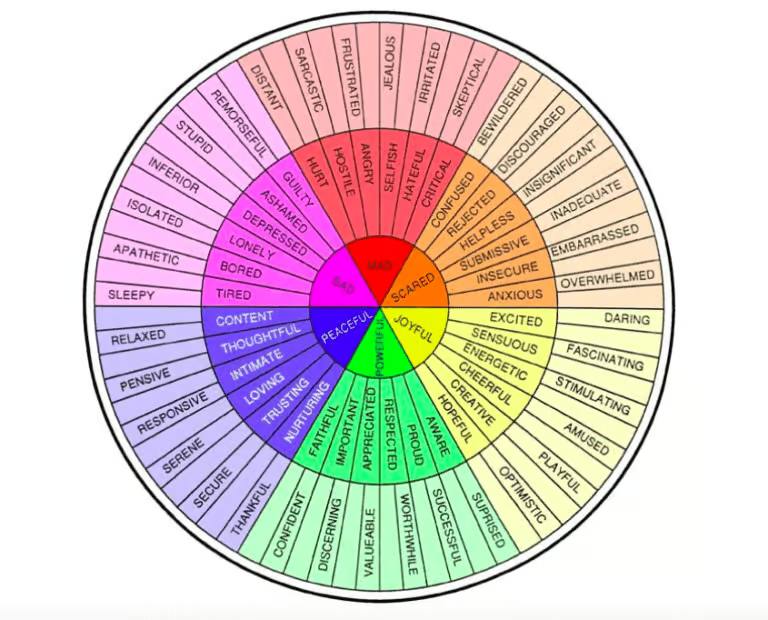
Prompts: Keep it simple
Use this set of prompts to write a brief but colorful snapshot of your journey with chronic illness.
- Say something unique about yourself. It could be anything: hobbies, favorite places or foods, fun memories, your quirks/dreams/fears, etc.
- When did you realize something was wrong? How did it make you feel?
- Describe your diagnosis and/or symptoms.
- Explain how your health condition has changed the way you live—what are the biggest challenges you experience?
- What has living with an autoimmune disease or chronic illness taught you?
- Give one piece of advice to someone who has recently been diagnosed or who’s experiencing health issues.
- Name one thing you’d like people to know about living with a condition like yours.
Prompts: Get inspired
Looking for more ideas? These questions can get the wheels turning when you want to share an in-depth look at your life, but you feel stuck. Writer’s block is no joke!
- What does a “typical” day look like for you?
- Describe your very first symptoms, including how you felt, where you were, how you reacted, etc.
- How has your perspective changed since you fell ill or were diagnosed? Do you see the world differently in some way?
- What is the best or worst experience you’ve had with a doctor?
- Living with chronic illness, it can often feel you have no control. What are some examples of things you’ve discovered are within your control?
- Describe a few challenges you’ve overcome. What have they taught you? What have they taught those around you?
- How has your illness impacted you financially?
- Is there one symptom you’d say is “the worst”?
- What does the word “support” mean to you? In what way have you been supported by others and vice versa?
- Have your relationships with friends and family changed? How so?
- Have you made diet and lifestyle changes? How have they impacted your symptoms, mental health, etc.?
- What were your favorites hobbies or activities before? What are they now?
- Has your career had to change? How so?
- What 3 adjectives would you use to describe yourself before chronic illness? And now?
- Have you hit “rock bottom” or a point where you felt completely hopeless? How did that transpire and how did you move forward?
- What are the most vibrant memories from your journey that stick out in your mind?
- How do you manage not just the symptoms, but the stress of being chronically ill?
- How do you distract yourself from pain or discomfort?
- What are your favorite ways to keep yourself in a calm state of mind?
- What is one comment you wish people would stop making?
GAI’s Autoimmune Stories – a moving collection of autoimmune disease & chronic illness experiences.

“Illness did not end my artistic life. It forced a deep reconfiguration of my relationship with music, leadership, and creation. Excess was stripped away, urgency gave way to attention, and artistic practice became more concentrated, more intentional, and more human.”

“For seven months, my pleas for answers were met with dismissals: “It’s just anxiety.” Appointment after appointment blurred together. I fought, not just to be heard by doctors, but to find the person I once was.”

"It took 7 years and a whole lot of persistence to finally get answers. And even when I did, the answers came with more layers: conflicting diagnoses, medication side effects, and constant uncertainty. But I kept showing up."

"My complaints of discomfort fell on deaf ears. The doctors attributed the pain to my past surgeries while confronting me with skepticism as if I were a hypochondriac. Despite presenting extensive research I had meticulously collected on my symptoms, the doctors swiftly brushed aside any consideration of a possible Ankylosing Spondylitis diagnosis."

"In the beginning of my diagnosis, it shattered every kind of normalcy I had. I went half-blind and still am to this day. Being the independent woman that I am, battling this crippling disease was extremely humbling, and I had to finally accept help from others."

"Being diagnosed with an autoimmune disease at the prime of my life was definitely not something that I had factored in. I was a young woman with dreams of traveling the world and no ceiling on her ambitions."

"Support is essential, especially for a person who deals with invisible pain which might lead to depression and low self-esteem.”

"I am sure that my diagnoses were delayed due to the fact I am a young woman. My experiences have shown how biased the healthcare system is in how it treats men and women."

"With an illness, you feel similar to Sisyphus: one day you have rolled the rock almost to the top, and the next day the boulder rolls over you and down towards the valley again."
Share your story
Once you’ve written your autoimmune or chronic illness story, you can either keep it for yourself (which is 100% ok!) or share it with others.
Add your voice to the chronic illness and autoimmune community on Instagram, Facebook, Twitter, sites like A Chronic Voice, The Mighty, Medium, specific autoimmune disease organizations, and – of course – the Global Autoimmune Institute.
If you’re sharing on social media, don’t forget the hashtags #spoonie #spoonielife #spooniesupport #chronicillness #chronicpain #invisibleillness #butyoudontlooksick #autoimmuneaware #autoimmunestories