
Trump’s Women’s Health Order: What Changes for Autoimmune Research?
On October 19, 2026, President Donald Trump signed Executive Order 14437, Advancing Women’s Health to Improve Outcomes in All Phases of Life. The order directs the establishment of a new Women’s Health Division within the National Institutes of Health (NIH) and creates a White House Women’s Health Task Force.
The order identifies autoimmune and inflammatory conditions among several areas requiring additional research, alongside cardiovascular disease, neurological disorders, chronic pain, and other conditions that disproportionately or uniquely affect women.
The initiative calls for improvements in research, prevention, diagnosis, and the translation of scientific discoveries into clinical care. However, many of these priorities were already part of existing federal women’s health research efforts. The new order introduces changes to federal leadership and coordination, raising questions about how those changes will affect ongoing NIH programs and autoimmune disease research.
NIH Discusses the Future of Women’s Health Research
At its October 20 advisory committee meeting, NIH leaders discussed the new Women’s Health Division alongside ongoing initiatives and scientific advances in autoimmune disease research.
Read the 65th ACRWH Meeting Highlights →What Does the New Women’s Health Executive Order Establish?
Section 2 directs the establishment of a Women’s Health Division within an existing NIH institute or center within 90 days. The division will coordinate with NIH’s Office of Research on Women’s Health (ORWH).
Its responsibilities include:
- Advancing research: Investigating understudied women’s health conditions and strengthening interdisciplinary scientific collaboration.
- Improving diagnosis and treatment: Promoting advanced research technologies, personalized medicine, and improved prevention and care.
- Addressing sex differences: Improving understanding of sex-specific health outcomes, strengthening the inclusion of women in clinical trials, and reinforcing NIH policies on sex as a biological variable.
- Translating research into care: Supporting the application of scientific discoveries to clinical practice and public health.
Sections 3 and 4 establish a White House Women’s Health Task Force, co-chaired by the Secretary of Health and Human Services and the White House Chief of Staff. The task force brings together leadership from federal agencies involved in research, healthcare, and public health to coordinate women’s health initiatives across the government.
The order also provides for consultation with outside stakeholders, including researchers, academic institutions, philanthropic organizations, and other interested groups.
How Does the New Initiative Compare With Existing Women’s Health Research Efforts?
Federal efforts to coordinate women’s health and autoimmune disease research were already underway before this announcement.
NIH’s Office of Research on Women’s Health (ORWH) was established in 1990, and Congress directed NIH to establish the Office of Autoimmune Disease Research (OADR) within ORWH in 2022.
NIH has also developed strategic plans addressing both research areas:
These plans address research priorities including interdisciplinary collaboration, precision medicine, and translating scientific discoveries into clinical care.
The Biden administration established a White House Initiative on Women’s Health Research in November 2023, followed by Executive Order 14120 in March 2024 to advance women’s health research and innovation. These earlier actions already identified autoimmune disorders as an area requiring greater research attention and emphasized interdisciplinary collaboration, public-private partnerships, clinical trial participation, and translating research findings into better patient care.
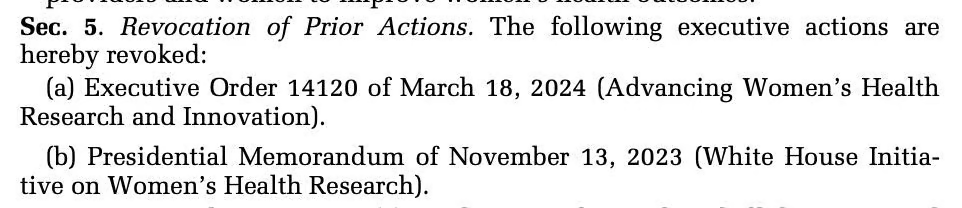
Section 5 of the October 2026 executive order explicitly revokes both the November 2023 presidential memorandum and Executive Order 14120.
The new order establishes a Women’s Health Division within NIH and a White House task force with specified leadership and coordination responsibilities. However, it does not identify which NIH institute or center will house the division or explain how its work will be divided among existing NIH offices, including ORWH and OADR.
What Does Trump’s Women’s Health Order Mean for Autoimmune Research?
Autoimmune diseases disproportionately affect women, making them an important area of women’s health research. The executive order’s emphasis on earlier diagnosis, personalized medicine, sex-specific research, and interdisciplinary collaboration is relevant to longstanding challenges in understanding and treating these conditions.
However, the order does not establish a new autoimmune-specific research program or announce dedicated funding for autoimmune disease research. Its implementation is subject to the availability of appropriations, as specified in Section 6.
The funding implications are particularly important when comparing the new order with the March 2024 executive order it revokes. The earlier directive required federal agencies to assess gaps in women’s health research funding and recommend additional investments. The October 2026 order does not include an equivalent requirement or specify how the new NIH Women’s Health Division will be funded.
This raises questions about whether the new initiative will expand federal research investment or primarily reorganize existing resources. Although the order does not direct cuts to autoimmune disease research, replacing explicit funding-related requirements with broader research priorities provides less clarity about the administration’s plans for future investment.
Several important questions remain:
- Research funding: Will additional resources be allocated to women’s health and autoimmune disease research, or will the new division operate using existing NIH resources?
- Existing programs: How will the new NIH division coordinate with ORWH and OADR, and will the changes affect implementation of existing NIH strategic plans?
- Research priorities: Will particular autoimmune diseases or research gaps receive additional attention?
- Collaboration: What opportunities will be available for researchers, patient organizations, and philanthropic institutions to participate?
The order recognizes autoimmune disease as a research priority, but recognition does not necessarily translate into additional research investment.
How the administration funds and implements the new initiative will ultimately determine whether it expands opportunities for autoimmune disease research or changes how existing federal resources are distributed.

References
- Executive Order 14437 (October 19, 2026). Advancing Women’s Health to Improve Outcomes in All Phases of Life.
- Executive Order 14120 (March 18, 2024). Advancing Women’s Health Research and Innovation.
- Presidential Memorandum (November 13, 2023). White House Initiative on Women’s Health Research.
- NIH Office of Research on Women’s Health. NIH-Wide Strategic Plan for Research on the Health of Women (2024–2028).
- NIH Office of Research on Women’s Health. NIH-Wide Strategic Plan for Autoimmune Disease Research (2026–2030).